Real Palletising ROI in 2026
Palletising automation has moved beyond being considered a future facing improvement or a discretionary capital project. In 2026, it has become an operational safeguard for manufacturers navigating sustained labour shortages, rising employment costs, and increasing pressure to expand throughput without expanding physical footprint.


Despite the rapid growth in robotic palletising solutions, the same question continues to dominate internal investment discussions: what is the real return on investment, and how long does it take to achieve payback under realistic operating conditions?
Historically, ROI calculations for palletising automation focused almost exclusively on direct labour replacement. If a system removed two operators per shift, the capital expenditure was benchmarked against wage savings and the payback period was calculated accordingly. While this approach remains relevant, it no longer reflects the operational realities facing manufacturers in the current climate.
The labour challenge in 2026 is not simply one of cost escalation. It is increasingly one of reliability and availability. Repetitive, physically demanding end-of-line roles remain among the most difficult positions to recruit for and retain. High turnover rates, absenteeism, reliance on agency workers, and the ongoing need for training cycles create instability that directly affects output consistency. These disruptions rarely appear clearly in financial models, yet they influence productivity, planning accuracy, and supervisory burden on a daily basis.
Manual palletising also carries measurable safety exposure. Musculoskeletal injuries, fatigue related performance decline, and long-term sickness absence remain prevalent risks in end-of-line operations. While insurance premiums and compliance costs are visible, the indirect operational impact is often greater. Reduced shift efficiency, administrative overhead, and morale implications can all erode productivity in ways that are difficult to quantify but impossible to ignore.
In addition to labour instability and safety exposure, manual palletising introduces variability in throughput. Human performance fluctuates across shifts, particularly in high-volume or multi-shift environments. End-of-shift slowdowns, inconsistent stacking quality, and missed takt times can disrupt downstream logistics and compromise production planning accuracy. Robotic palletising systems, by contrast, deliver consistent cycle times and repeatable stacking precision. This predictability stabilises the end-of-line and supports more accurate forecasting across the wider production process.
A common misconception is that palletising automation replaces only one or two operators. In practice, modern end-of-line systems frequently offset multiple rotating roles across shifts, reduce dependency on overtime, limit reliance on temporary labour during peak demand, and minimise downtime caused by injury or fatigue. When evaluated comprehensively, automation does not simply substitute labour; it removes volatility from a critical production stage.
Return on investment timelines vary according to system complexity and operational context. Standard industrial palletising systems deployed in high-volume, multi-shift environments typically achieve payback within eighteen to thirty months under realistic usage assumptions. Collaborative robotic palletising systems, which require lower upfront capital and offer faster deployment, often reach payback within twelve to twenty-four months, particularly in SME environments or lower-volume production lines. Modular and scalable palletising cells present a wider range, commonly achieving ROI within twelve to thirty-six months depending on phased investment strategies and product mix variability.
These timeframes assume practical operating conditions rather than idealised uptime or theoretical maximum throughput. Overstating performance assumptions remains one of the most common reasons ROI projections fail to materialise as expected.
In fact, automation ROI is most often undermined not by technology limitations, but by process misalignment. Over specifying equipment for hypothetical future scenarios, underestimating changeover requirements, neglecting upstream bottlenecks, or failing to integrate effectively within existing layouts can all delay payback. Successful automation projects begin with thorough process analysis and operational understanding rather than hardware selection.
It is also important to recognise that ROI in 2026 extends beyond financial metrics alone. Palletising automation increasingly functions as a strategic lever. It strengthens production resilience in volatile labour markets, reduces exposure to hard-to-fill roles, enhances workplace safety culture, and enables greater flexibility when introducing new product lines or responding to demand fluctuations. For many manufacturers, automation investment is now as much about risk mitigation and future scalability as it is about cost reduction.
A credible ROI assessment must therefore incorporate fully loaded labour costs, including turnover and training implications, alongside absence impact, throughput limitations, space constraints, forecasted volume growth, and lifecycle integration costs. Generic calculators frequently oversimplify this evaluation. A tailored, process-led assessment grounded in real operational data produces far more reliable projections.
In 2026,palletising automation should not be viewed simply as a mechanism for reducing headcount. It represents a means of protecting output, stabilising end-of-line performance, and enabling sustainable growth in an increasingly uncertain environment. The strongest returns are achieved when systems are designed around actual operational constraints rather than theoretical performance targets.
Manufacturers considering palletising automation should begin not with the question of what robot to install, but with a comprehensive evaluation of their current process stability, labour exposure, and growth trajectory. Only then can the true return on investment be accurately understood.


You may also be interested in
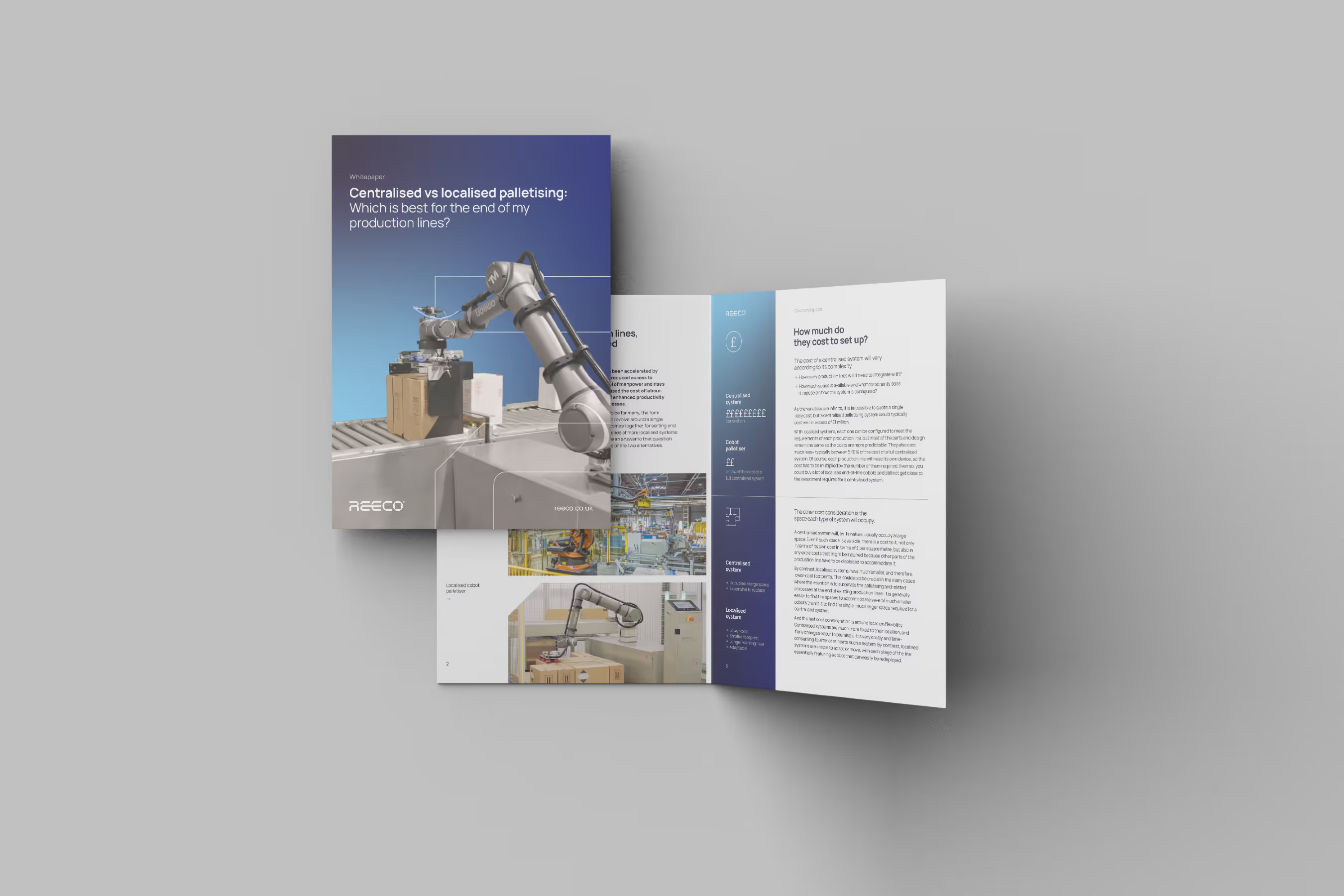
Centralised vs localised palletising: Which is best for the end of my production lines?
The move towards end-of-line automation has been accelerated by changes in the labour market post-Brexit. The reduced access to overseas workers has resulted in a smaller pool of manpower and rises in the statutory minimum wage has also increased the cost of labour. This has all added to the existing arguments of enhanced productivity and reliability for switching to automated processes.
.svg)
